Peter and Eva’s Grief Over Lieve’s Death
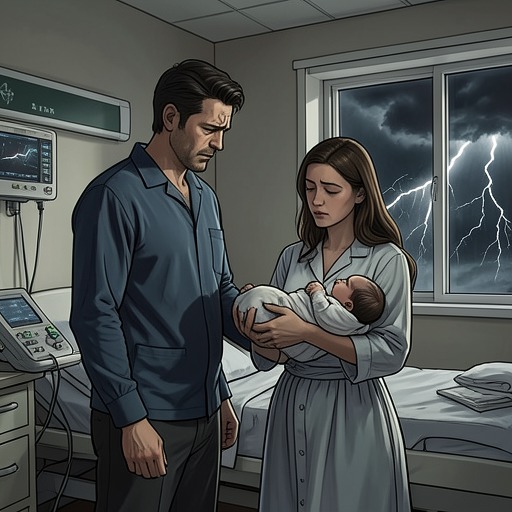
Nieuwe burenPeter and Eva’s Grief Over Lieve’s Death is not a single, shared state but a painful divergence in how two parents live with the death of their daughter. Peter tells Hetty that the grief no longer occupies every hour: he and Eva have new friends, he has returned to music and motorcycling, and they seem to have found a new equilibrium. Yet the therapy sessions bring the past back into the room. Eva, meanwhile, continues to hold fast to Lieve’s memory, and the prospect of another pregnancy makes mourning inseparable from hope, fear, and the question of what it means to remain a mother after losing a child.
Loss and the Uneven Work of Grieving
When Hetty asks whether Peter is sad, he describes a life that has begun to move again. The grief has worn down from its most constant intensity; music, motorcycling, and new friendships mark a return to activities and connections beyond the loss. He does not present this as forgetting Lieve, but as an apparent new balance for himself and Eva. At the same time, each visit to therapy reminds him of the suffering that came before, making recovery feel less like a clean departure than a repeated encounter with what remains.
Hetty challenges Peter’s account of that balance. She interprets his grief as deep and unresolved: he has lost not only a child but also the hope of having another, and, in her view, he pushes his sorrow aside because he believes Eva suffers more and has a greater claim to mourn. Her image of an ignored, festering wound gives language to the danger she sees in his composure. The scene establishes a tension between Peter’s sense that life has found a new rhythm and Hetty’s conviction that his apparent adaptation conceals pain. His grief is not absent simply because it is no longer present every moment.
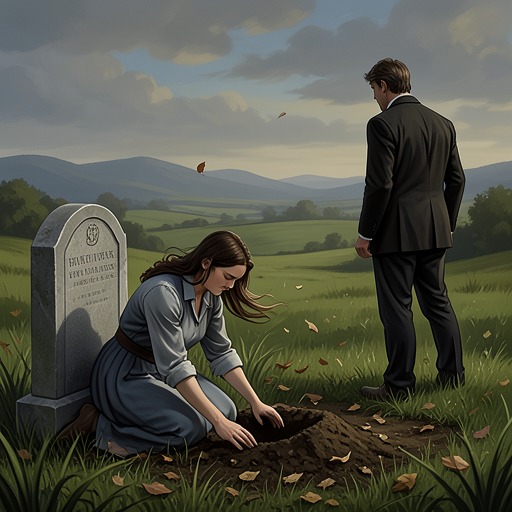
The cemetery makes that conflict concrete. Lieve lies in the children’s section beneath a white fieldstone inscribed with the words that she will remain in their hearts, among forget-me-nots. The surrounding toys, garden ornaments, and bright flowerbeds cannot dispel the sorrow of the place; nearby children’s voices make the contrast between living childhood and the dead child especially sharp. Eva has tended the grave, while Peter has not visited since the funeral. He comes now with a white rose, kneels beside the stone, and touches its cold surface. He admits that he had avoided the grave as a monument to his own failure, and that he wants to feel love for a child he experiences as not his, a child who never lived and with whom he could not form a bond. What he feels instead is guilt.
Eva’s Attachment to Lieve’s Memory
Eva’s grief is expressed through acts of remembrance and through her refusal to treat moving on as forgetting. On one morning, she realizes that several hours have passed without her thinking of Lieve, and the discovery frightens her. The details she clings to are intimate and physical: Lieve’s small, delicate body, closed fists, and fine hair. Eva insists to herself that she remains a mother who loves her daughter, even though the child died and Eva never truly got to know her.
The advice to let go comes from Hetty, Peter, Eva’s mother, and her brother. Eva experiences it not as comfort but as a demand to surrender the memories that preserve her identity as Lieve’s mother. She continues seeing Hetty because the sessions give her an hour in which she can speak about her sorrow, even as she doubts Hetty’s account of Lieve as a wise, loving Star Child whose soul was needed for something higher. That spiritual explanation offers a way to imagine meaning beyond the death, but Eva’s attachment remains rooted in the particular child she carried and lost, not only in an abstract account of her soul.
The photograph of Lieve becomes another focus for that attachment. Eva keeps it framed with a candle, though she believes others do not want to see it. To other people it may represent a dead baby and an unbearable injustice; to her it is a picture of her daughter, a child who grew inside her and of whom she is proud. She speaks to Lieve in her thoughts. The photograph keeps the child present in the household and allows Eva to assert a form of motherhood that the loss has not erased.
At the grave, the difference between the couple’s responses is visible in their gestures. Eva plucks dead flowers from the bed while Peter fills a watering can and waters the forget-me-nots. She holds her jaw tight and avoids his eyes, afraid that speaking will release a scream. He strokes her back and holds her hand, but also recognizes his jealousy of the dead child and of the intensity of Eva’s grief. Eva kneels, lays a hand on the stone, and softly greets Lieve as her daughter. The visit brings them together in care for the grave without making their inner experiences identical: Eva’s grief is immediate and openly embodied, while Peter’s is entangled with guilt and with his awareness of how deeply she mourns.
Work, Routine, and the Possibility of Another Child
The return to ordinary life offers Eva distraction, but not simple relief. After more than a year of mourning, she goes back to work as a teacher at the end of summer. The heat makes a classroom of thirty children uncomfortable, and she returns to other people’s children while hoping they will forget the pregnancy that ended in loss. Their presence does not absorb her attention so much as expose the distance between the life she is living and the family she had hoped to have.
When Eva suspects that she may be pregnant again, grief and expectation begin to overlap. She calculates the odds, weighing the chance of conception against the risk of miscarriage, while also acknowledging that Peter is unhappy, Steef is angry, and her marriage is in danger. Those crises feel strangely remote beside the question of whether a child might be growing inside her. After returning to work, she is distracted by the heat, by her body, and by the possibility that her pupils might notice her changing shape. She has not prepared for the school year. The classroom is both her workplace and a daily encounter with the lively children she cannot have as her own.
As she waits to take a test, Eva becomes alert to bodily sensations she fears and hopes to interpret: tense breasts, nausea at the smell of coffee, and anxiety about running, cycling, or driving over rough roads. She knows the chance of pregnancy is small, yet lets herself imagine that, if she is pregnant, someone above has granted her another chance. This hope is not a resolution of her grief. It is hope formed in the shadow of Lieve’s death, and each sign in her body carries the possibility of joy alongside the memory of what can be lost.
The image of Lieve remains close during this uncertainty. Eva keeps a photograph by her bedside, showing the baby in a knitted sweater made by Eva’s mother and wrapped in the quilt Eva made. The photograph is marked by the tears and pressure of her pillow. Looking at it, Eva comforts herself with the thought that things can never be as bad as they were and that she can always go to Lieve. That thought helps her get up, shower, and face a day of singing, craft activities, meetings, and conversations with worried parents. The children’s noise and exuberance, which others might find exhausting, are precious to her precisely because she has seen a child dead.
Lieve’s Death in the Family’s Continuing Story
Eva recalls that during Peter’s work trip to the European Championship in Portugal, she was pregnant with Lieve and surrounded by relatives who brought healthy meals, juices, and baby clothes. Peter joked that the Netherlands would win the tournament because Eva was pregnant; three weeks after the team was eliminated, Lieve died. The memory holds a brief picture of family anticipation beside the abrupt fact of loss. It also shows how the pregnancy had gathered relatives around Eva and how the death came after a period in which the future had seemed shared and secure.
For Peter, the possibility of another child carries a different pressure. During a night of sleeplessness, he cycles through doubts about whether he made the right decision involving Steef, whether they should adopt, and whether he can bear to see Eva with Steef. He searches mentally for a guide that might help him let Eva go and loosen his fear of his own limits. His grief therefore meets not only the question of parenthood but also the instability of his marriage and his anxiety about what the couple may do next.
For Eva, the desire for another child is rooted in a longing that predates Lieve’s death: she remembers wanting a child of her own while teaching young children, and imagining pregnancy, birth, and the lasting bond between mother and baby. She had wanted that life with Peter, and Lieve’s death did not extinguish the desire. Rather, it made the longing more charged. When Eva imagines pregnancy again, she remembers the first pregnancy and the child who died, while the prospect of a new child feels like a second chance that she must protect.
Separation and the Persistence of Grief
The couple’s grief is further strained by Peter’s growing distress and Eva’s withdrawal. She sees him becoming stranger and more restless, sleeping badly and moving his computer, music, and guitar into the living room because he finds the study stifling. Pink Floyd plays as he repeats the same passage. Eva can barely tolerate his presence; she sees pain in his pleading eyes but turns away, feeling unable to give him attention. The loss they share does not guarantee mutual comfort. Their diverging needs become part of the marital breakdown unfolding around them.
As Eva weighs the possibility of pregnancy, her attention is also seized by the question of whether Steef is a murderer. She recalls seeing him with a pistol and pursuing a boy, and knows of his post-traumatic stress disorder and prior killing. Then she tries to reason herself away from suspicion: Steef denies the killing, the dead boy had links to crime and blackmail, and others could have been responsible. This fear does not replace her grief, but competes with the pregnancy question and narrows her sense of what matters. In the same moments, she remembers the bodily experience she wanted so intensely: a living child growing inside her, and the permanent bond she once imagined motherhood would bring.
Eventually, Eva leaves Peter. She thinks of the house as a place of pain and says she is not afraid to leave the life they had imagined there, though she fears the unknown and has never been good at being alone. Looking back, she remembers that she and Peter began living together when she was seventeen, that she had been certain he was the one, and that she wanted a family with a husband who wanted one too. She now describes her love for him as gone and wonders whether she would have found the courage to leave if she were not pregnant. Her answer is that she chooses the child, not herself. The separation does not undo Lieve’s death or settle Eva’s grief; it shows how loss has become part of the decision about what future she can still choose.